If you are planning a new driveway, patio extension, or slab and the calendar has rolled into December, you may assume the project has to wait until spring. It is one of the most common questions homeowners in Greenville ask: can you actually pour concrete in winter in Upstate SC? The short answer is yes, and more easily than most people expect. Upstate winters are mild enough that residential concrete work continues safely through the coldest months, as long as the crew understands how to manage the handful of variables that cold weather introduces. You do not have to lose three or four months of the year waiting for warm weather to get quality flatwork.
The reason winter pouring works so well here comes down to one simple fact about our climate, which we call the 40 degree and rising benchmark. In the Upstate, it rarely stays below freezing during daytime working hours, even in the heart of winter. That single detail is what separates concrete work in Greenville from concrete work in the northern states, and it is why a well-run winter pour here can deliver results every bit as strong and durable as one poured in June. This guide explains exactly how it works, what a good contractor does differently in cold weather, and how to plan a winter project with confidence.
Yes, You Can Pour Concrete in Winter in the Upstate
Concrete is poured year round across South Carolina, and winter is no exception for residential projects like driveways, patios, walkways, and slabs. The concern people carry into winter comes from a real place, since freezing temperatures genuinely can damage fresh concrete. But the key word is freezing, and the Upstate simply does not spend much of the winter there during the hours when concrete is placed and finished.
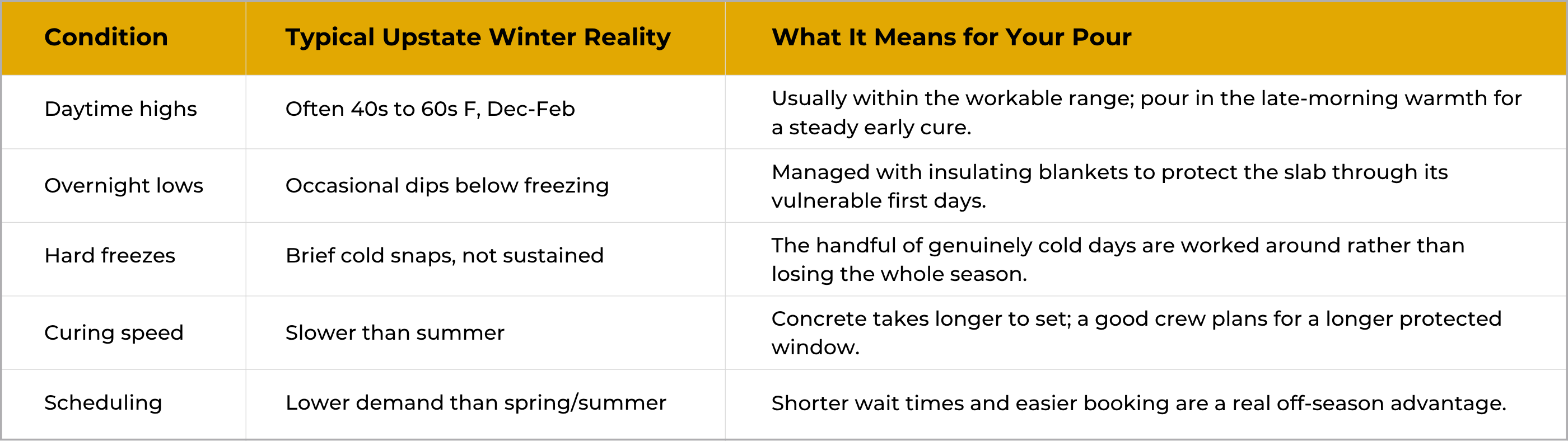
Greenville sits in a humid subtropical climate. Our winters are short and mild compared with most of the country. Daytime highs in December, January, and February frequently land in the 40s, 50s, and even 60s, which is squarely inside the range where concrete cures well. Hard freezes do happen, but they tend to arrive as brief overnight cold snaps rather than the sustained deep freezes that shut down concrete work for months up north. That distinction is the whole ballgame. A crew that pours in the morning, monitors the forecast, and protects the slab overnight can work through nearly the entire Upstate winter without compromise.
The 40 Degree and Rising Benchmark
Here is the practical rule that makes winter pouring dependable in the Upstate. What matters most for a successful cold-weather pour is not the overnight low but the temperature during and just after placement, and whether it is holding steady or climbing. When the thermometer reads 40 degrees and rising as the morning warms, conditions are right to pour. The concrete goes down into workable conditions, the day’s warmth helps it gain early strength, and by the time temperatures drop again that evening the slab has had hours to begin setting.
This is why a winter pour in Greenville is usually scheduled for late morning rather than first light. A good crew watches the forecast for a day when the daytime trend climbs comfortably into the 40s or above and stays there through the critical early hours of curing. On the great majority of Upstate winter days, that window exists. The occasional stretch of genuinely cold, sub-freezing daytime weather is the exception, and those days are simply worked around. Rather than losing the whole season, you lose only a handful of days here and there.
Why Upstate Cold Weather Requires a Different Approach
Winter pouring is completely viable, but it is not identical to summer pouring. Cold slows down the chemical reaction that gives concrete its strength, a process called hydration. In warm weather that reaction moves quickly; in cold weather it slows, which means the concrete takes longer to set and gain strength, and it stays vulnerable for longer. The job of an experienced contractor is to manage that longer, more delicate curing window so the slab reaches full strength without ever being allowed to freeze in its early hours.
The single greatest risk in cold-weather concreting is fresh concrete freezing before it has developed enough strength to resist it. When water inside very young concrete freezes, it expands and can disrupt the internal structure, leading to weakness and scaling later on. Concrete generally needs to reach a compressive strength of about 500 psi before it can safely withstand a freeze, which under Upstate winter conditions typically means protecting it through at least the first day or two. This is not difficult to achieve here, but it is the reason a winter pour has to be actively managed rather than poured and forgotten.
How Sampson Concrete Manages Winter Pours
Delivering flawless winter results comes down to method, and a crew that pours through Upstate winters has a routine for it. The specific steps we take depend on the day’s forecast, but the toolkit is consistent.
We time the pour to the warmest part of the day. Scheduling placement for late morning takes advantage of the 40 degree and rising window and gives the slab maximum daylight warmth to begin curing before evening.
We watch the multi-day forecast, not just pour day. Because fresh concrete stays vulnerable longer in the cold, we plan around the overnight lows for the first day or two after placement, not only the conditions during the pour itself.
We protect the slab from overnight freezes. Insulating concrete blankets are the workhorse of winter concreting. Laid over a fresh slab, they trap the heat that hydration naturally generates and keep the surface well above freezing through a cold night. On the coldest jobs, additional measures hold that warmth in.
We adjust the mix when conditions call for it. Cold-weather pours can use accelerating admixtures that speed up early strength gain, or adjustments to the mix design that reduce the time the concrete spends vulnerable. This shortens the risky early window.
We prepare the subgrade properly. Concrete should never be placed on frozen ground, which can settle unevenly as it thaws. We make sure the base is properly prepared, and the Upstate’s dense red clay subgrade, which holds moisture and drains slowly, gets particular attention so a wet or frozen base does not undermine the pour.
Winter Pouring Conditions in Upstate SC at a Glance
The table below summarizes how the winter months tend to perform for residential concrete work in the Greenville area, so you know what to expect when planning a cold-season project.
The Upside of Pouring Concrete in Winter in Greenville
Beyond the fact that winter pouring simply works in the Upstate, there are real advantages to booking a cold-season project. Demand for concrete work drops once the peak spring and summer rush passes, which means winter often brings the shortest wait times of the year and the easiest scheduling. If you have been putting off a driveway or patio, the off-season can be the fastest way onto the calendar. The mild daytime temperatures that make winter curing so workable also tend to come with lower humidity and less of the intense sun that forces crews to race the clock in July. For homeowners planning ahead, a winter pour can mean a finished, cured driveway ready to enjoy the moment spring arrives, rather than joining the springtime waitlist. Anyone weighing the long-term investment can review our concrete driveway maintenance guide for Greenville homeowners to understand how proper sealing and care protect that investment through every season.
How Greenville Homeowners Can Prepare for a Winter Pour
If you are considering a winter concrete project in the Upstate, a few steps help everything go smoothly. Stay flexible on the exact pour date, since the best winter pours are scheduled around the forecast, and a two or three day window gives your contractor room to pick the ideal day. Keep the work area clear and accessible so the crew can prepare the subgrade and place the concrete efficiently during the warmer midday hours. Plan for a slightly longer curing period before heavy use, because cold weather means the slab needs more time to reach full strength, so a driveway may need a little longer before you park on it. Most importantly, hire a contractor with genuine local cold-weather experience. The difference between a winter pour that lasts for decades and one that scales or cracks within a few years comes down almost entirely to whether the crew knows how to manage Upstate winter conditions. When you are comparing quotes, ask directly how the contractor handles freeze protection and mix adjustments in cold weather.
Frequently Asked Questions
Can you pour concrete in winter in Upstate SC?
Yes. Upstate winters are mild enough that daytime temperatures usually fall within the workable range for concrete, and residential projects like driveways and patios continue through the winter. The key is scheduling the pour for the warmer part of the day and protecting the slab from overnight freezes during its first day or two.
What temperature is too cold to pour concrete?
The concern is not a single air temperature reading but whether fresh concrete freezes before it gains enough strength. As a working rule, conditions are right when the daytime temperature is around 40 degrees and rising. Below that, or when concrete cannot be protected from an early freeze, a pour should be rescheduled or managed with cold-weather methods.
Will freezing temperatures ruin a concrete driveway?
Freezing only causes damage if it reaches the concrete while it is still very young and has not yet gained strength. Once concrete reaches roughly 500 psi, usually within the first day or two under Upstate conditions, it can safely handle a freeze. This is exactly why crews use insulating blankets and mix adjustments to protect a slab through its vulnerable early window.
How long does concrete take to cure in cold weather?
Cold slows the curing reaction, so winter concrete takes longer to gain strength than summer concrete. It may be ready to walk on in a couple of days and to drive on in a bit over a week, but the exact timeline depends on the temperatures during curing. A local crew plans for this longer protected window.
Is winter a good time to schedule a concrete project?
For many homeowners, yes. Winter demand is lower than the spring and summer peak, so wait times are often shorter and scheduling is easier. As long as the work is handled by a crew experienced in Upstate cold-weather pours, a winter project can deliver the same durable result while getting you on the calendar sooner.
Ready to Pour This Winter?
Winter does not have to put your concrete project on hold. In the Upstate, mild daytime temperatures and the 40 degree and rising benchmark make cold-season pouring a dependable, high-quality option for driveways, patios, and slabs, as long as the crew knows how to protect and manage the slab through winter conditions. At Sampson Concrete, we pour year round across Greenville and the surrounding Upstate, using proven cold-weather methods to deliver flawless results without structural weaknesses, whatever the season. Contact us today for a free estimate and let us help you plan a winter project built to last.