A well-placed walkway does more than get you from the driveway to the front door. It shapes the first impression of your home, keeps foot traffic off the grass, and ties your whole landscape together. If you are planning a new path or replacing a cracked one, the first question is almost always the same: what does a concrete walkway cost in Greenville? The short version is that most residential walkways here land somewhere between a modest few hundred dollars for a small, simple path and several thousand for a longer, decorative one. The real number depends on size, finish, site prep, and a few local factors specific to the Upstate.
This guide breaks down what drives the price, the design options worth considering, the code and permit rules that apply around Greenville, and how to make sure your new walkway actually lasts. We install walkways and sidewalks across the Greenville area, so this is the same walkthrough we give homeowners before we ever quote a job.
What Does a Concrete Walkway Cost in Greenville?
Let us start with the number you came for. For a standard, broom-finished concrete walkway in the Greenville area, most homeowners pay somewhere in the range of 8 to 12 dollars per square foot installed, which covers the concrete, labor, and a basic finish. Decorative options climb from there. The catch is that square-foot pricing only tells part of the story, because two walkways of the same size can cost very different amounts once site conditions and finish come into play.
Typical price ranges by finish
Here is a realistic look at what different walkway finishes tend to run in the Upstate, installed. These are planning ranges, not quotes, since every site is different.
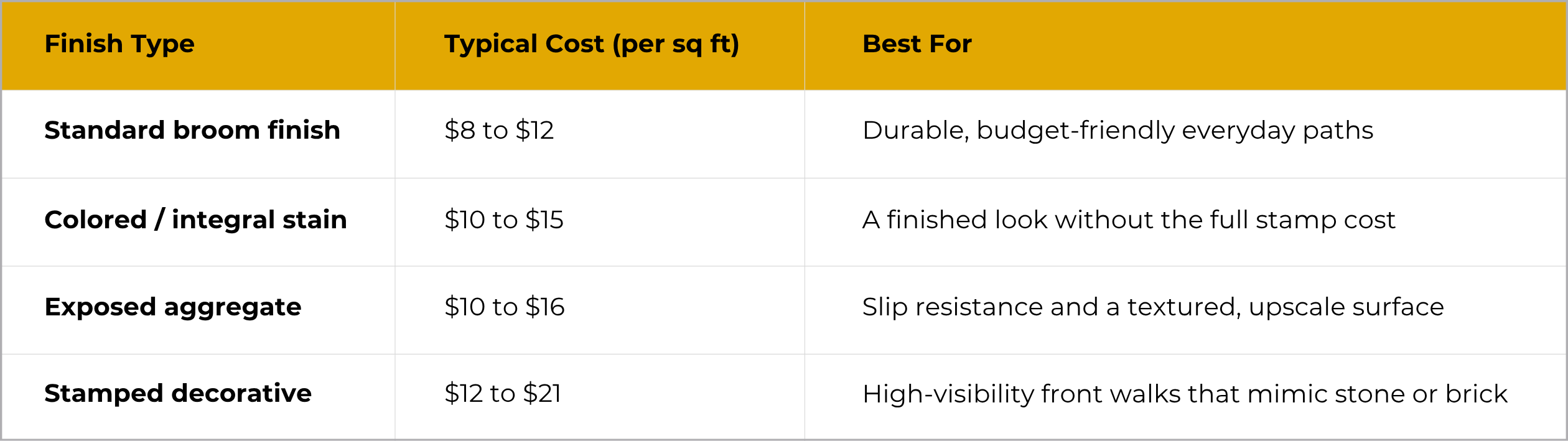
To put that in real terms, a simple 3-foot-wide path running 30 feet from the driveway to the porch is about 90 square feet, which at a standard finish tends to land in the neighborhood of 700 to 1,100 dollars. Step that same path up to a stamped finish and you are looking at closer to 1,100 to 1,900 dollars. Longer runs and wider paths scale up from there.
What drives the price up or down
Beyond finish, a handful of factors move the final number. When you are budgeting, these are the ones to keep in mind:
- Size and width. More square footage means more concrete and labor. A standard residential walkway is 3 to 4 feet wide; wider paths cost more but feel more generous.
- Thickness and reinforcement. A path built at 4 inches with wire mesh or fiber reinforcement costs a little more than a bare minimum pour, and it is money well spent for longevity.
- Site preparation. Excavation, grading, and hauling off old concrete all add to the total. Removing an existing cracked walkway typically adds a modest per-square-foot charge.
- Slope and access. A sloped yard or a spot the crew cannot easily reach with equipment takes more time and labor.
- Shape and curves. Straight runs are cheapest. Curves, bends, and custom layouts require more forming work and drive up labor.
- Finish complexity. A single-color stamp costs less than a multi-pattern, multi-color decorative job.
Design Options for Greenville Walkways
Concrete is far more versatile than the plain gray slab most people picture. The right finish can make a walkway a genuine feature of your landscape rather than just a functional necessity.
Finishes worth considering
Each finish has its own look, feel, and price point. The most popular choices around Greenville include:
- Broom finish. The classic. A lightly textured, slip-resistant surface that is durable, affordable, and works with any home style.
- Exposed aggregate. Washes away the top layer to reveal the stone within, giving a natural, pebbled texture with excellent traction.
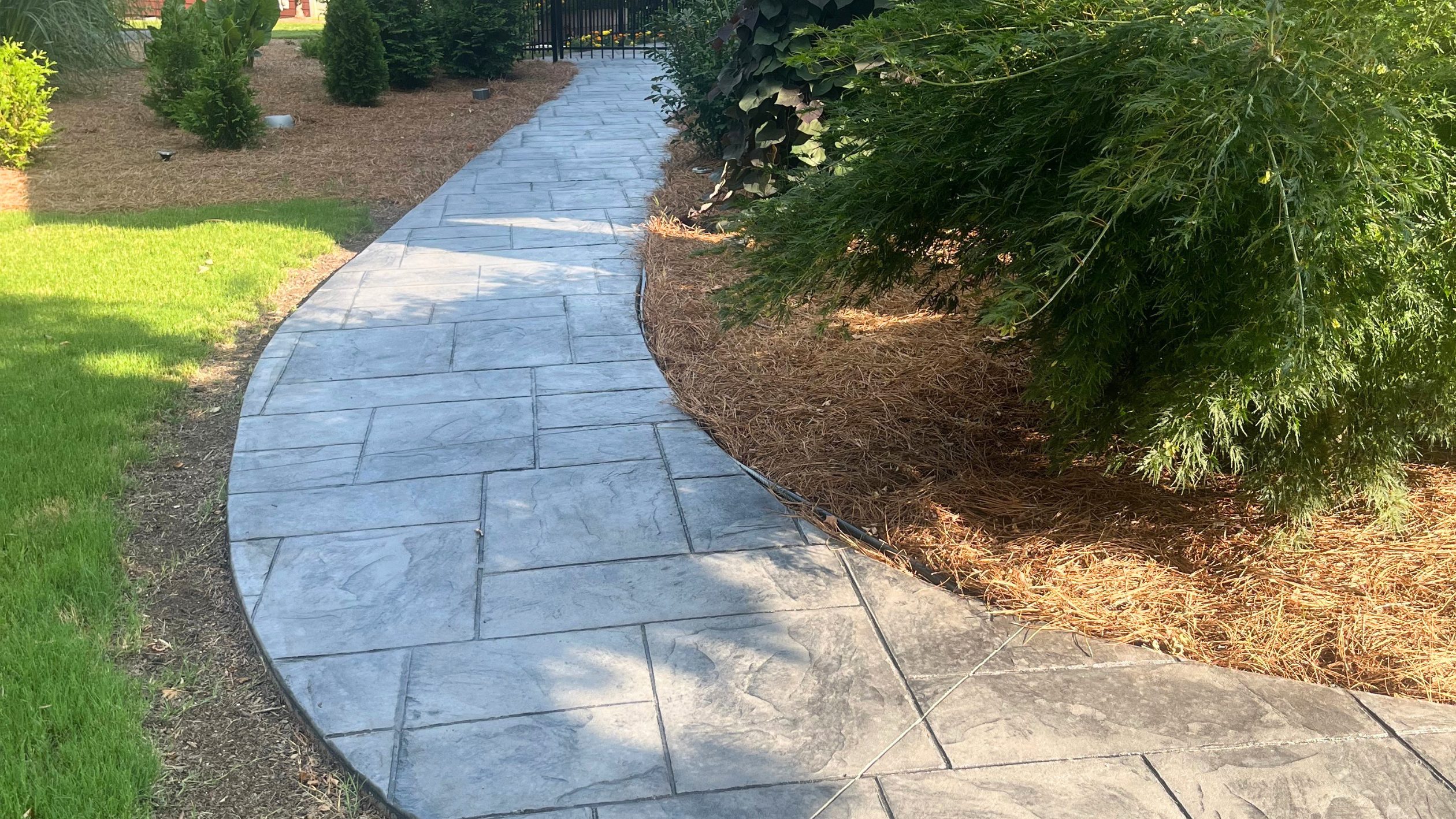
- Stamped concrete. Pressed with patterns while curing to mimic brick, slate, flagstone, or cobblestone at a fraction of the price of the real material.
- Colored concrete. Integral color mixed into the pour, or stains applied after, for a warmer, more custom look than standard gray.
Practical design choices that matter
Looks aside, a few design decisions affect how well the walkway works day to day:
- Width. Three feet lets one person pass comfortably; four feet lets two walk side by side. For a main front walk, wider usually feels better.
- Curves versus straight lines. A gentle curve can soften a landscape and feel more inviting, though it adds a little to the cost.
- Jointing and layout. Proper control joints are not just cosmetic. They tell the concrete where to crack, which keeps your surface clean and intact for the long haul.
- Drainage. Where the water goes matters as much as where the path goes, which is especially true in the Upstate. More on that below.
Permits and Code: What Greenville Homeowners Should Know
Most residential walkways poured entirely on your own property do not require a building permit. But there are real exceptions around Greenville, and getting this part wrong can be costly.
When a permit comes into play
A private walkway winding through your backyard is usually free of red tape. The picture changes when your project touches public property or reshapes your lot. Watch for these triggers:
- Public right-of-way. If your walkway connects to or crosses a public sidewalk, or if you are building a sidewalk in the strip between the street and your property line, you are likely into permit territory and may need an encroachment permit from the county or city.
- City versus county. Whether you fall under the City of Greenville or unincorporated Greenville County determines which office and which rules apply. They are separate jurisdictions, and nearby towns like Easley, Greer, and Simpsonville add their own layer.
- Setbacks and drainage. Even a permit-exempt path still has to respect zoning setbacks, and significant regrading that changes how stormwater moves can require review.
- HOA rules. If you are in a neighborhood with a homeowners association, its covenants may restrict walkway placement or finish regardless of what the city allows.
A note on width and accessibility
For private residential walkways you have flexibility, but there is a sensible standard worth following. A minimum width of 36 inches keeps a path comfortable and functional, and if your walkway ties into any public or shared accessible route, ADA guidelines and local code set firmer requirements. A local contractor will know which standard applies to your specific project, so nothing gets flagged later.
Why the Upstate's Red Clay Makes Site Prep Critical
Here is the factor that separates a walkway built to last from one that cracks within a couple of winters, and it is specific to our region. Upstate South Carolina sits on dense red clay soil. That clay holds water and drains slowly, and it swells when saturated and shrinks as it dries. Over a season of heavy Greenville rain followed by dry spells, that constant movement underneath a slab is exactly what causes walkways to crack, heave, and settle unevenly.
The fix is not fancier concrete on top. It is proper preparation underneath.
How the base protects your walkway
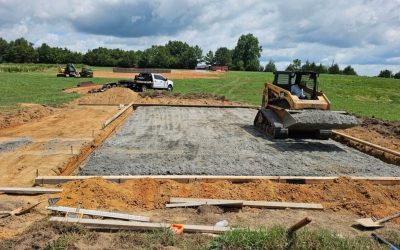
Getting the foundation right is where a qualified crew earns its keep. Proper site prep for Upstate clay generally means:
- Excavating to the right depth. Digging out enough soil to make room for a stable base rather than pouring on disturbed or loose ground.
- Building a compacted gravel sub-base. A well-compacted layer of gravel gives the slab a stable, draining foundation that buffers it from the clay’s movement.
- Grading for drainage. Sloping the site so water runs off and away rather than pooling under or beside the walkway, where it would keep the clay saturated.
- Reinforcing the pour. Wire mesh or fiber reinforcement helps the slab resist the stresses that soil movement puts on it.
Skip these steps to shave a few dollars, and the clay will find the weakness. This is the single biggest reason we tell homeowners that who pours the walkway matters as much as what it is poured with.
Maintaining Your Concrete Walkway
A properly built concrete walkway is low maintenance, not no maintenance. A little care keeps it looking sharp and extends its life by years.
- Seal it. A quality sealer applied after curing, and reapplied every few years, protects against moisture, staining, and surface wear. Decorative finishes especially benefit.
- Clean it periodically. Rinsing off dirt, leaves, and organic buildup prevents staining and the slick film that can develop in shady, damp spots.
- Address cracks early. Small cracks are easy and cheap to seal. Left alone, water gets in, the clay moves, and a hairline becomes a real repair.
- Keep an eye on drainage. Make sure downspouts and grading continue to send water away from the path, not toward it.
Why Hire a Qualified Greenville Concrete Contractor
Pouring a walkway looks simple from the curb. The difference between one that stays flat and clean for decades and one that cracks and settles comes down to the parts you cannot see: the excavation depth, the compacted sub-base, the drainage grading, and the reinforcement. A top-rated Greenville concrete contractor gets the foundation right for our clay soil, handles any permit or right-of-way requirements, and builds in the control joints and drainage that prevent problems before they start. When you are comparing quotes, ask each contractor how they will prepare the base and manage drainage. The answer tells you whether you are buying a walkway or buying a future repair. If you want to see how we approach exterior flatwork from the ground up, our concrete sidewalk and walkway services page walks through our process.
Frequently Asked Questions
How much does a concrete walkway cost in Greenville, SC?
Most standard broom-finished walkways in the Greenville area run about 8 to 12 dollars per square foot installed, so a typical 90-square-foot front path lands roughly between 700 and 1,100 dollars. Decorative finishes like stamped concrete push that higher, and site prep, removal of old concrete, and curves all affect the final number. A local estimate is the only way to get an exact figure for your project.
Is a concrete sidewalk cheaper than pavers?
Usually, yes. Poured concrete typically costs less than a paver walkway of the same size, both upfront and over time, since pavers are labor-intensive to install and can shift or grow weeds at the joints. Stamped concrete offers a middle path, giving you the look of pavers or stone at a lower cost while keeping a single continuous surface.
Do I need a permit to build a walkway in Greenville?
A walkway poured entirely on your own property usually does not need a building permit, but it still has to meet zoning setbacks and, in an HOA, any covenant rules. If the walkway connects to a public sidewalk or sits in the road right-of-way, you likely need an encroachment permit, and whether you fall under the City of Greenville or the county determines the exact requirements.
How wide should a residential walkway be?
Thirty-six inches is a good minimum, letting one person walk comfortably. For a main front walkway, four feet is popular because it lets two people walk side by side. If your path connects to a public accessible route, ADA and local code may set firmer width and slope requirements.
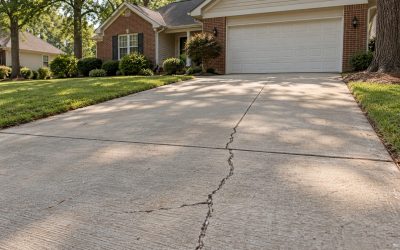
Why do concrete walkways crack in the Upstate?
The most common culprit is our dense red clay soil, which swells when wet and shrinks when dry, moving the ground beneath the slab through Greenville’s wet and dry cycles. Cracking is largely preventable with proper site prep: excavation to the right depth, a compacted gravel sub-base, drainage grading, and reinforcement in the pour.
Ready to Add a Walkway That Lasts?
A concrete walkway is one of the most cost-effective upgrades you can make to your property, as long as it is built for Upstate conditions from the ground up. Whether you want a simple broom-finished path to the front door or a stamped walkway that turns heads, the finished result comes down to smart design, the right prep for our clay soil, and clean execution. At Sampson Concrete, we install walkways and sidewalks across Greenville, Easley, Greer, and Simpsonville, handling everything from base preparation and drainage to the final finish. Contact us today for a free estimate and let us build you a path that still looks great in twenty years.