If you are planning a new driveway, patio, or slab, one of the smartest questions you can ask before you sign a contract is when the work should actually happen. Timing affects how well concrete cures, how strong the finished surface ends up, how much you pay, and how long you wait to get on the schedule. In Upstate South Carolina, the answer is more flexible than it is in colder parts of the country, but it is not as simple as “any warm day will do.” The best time of year to pour concrete in Upstate SC is generally fall through early spring, when mild temperatures and lower humidity give the slab the steady, unhurried cure that produces a long-lasting result. That said, every season here is workable with the right planning, and this guide walks through exactly what changes month to month so you can time your project with confidence.
At Sampson Concrete, we pour year round across Greenville and the surrounding Upstate, so this is not theory for us. It is the daily reality of scheduling crews around the local climate. Below, we break down how heat, cold, humidity, and rainfall each affect a pour, which months tend to give the best results, how timing influences pricing and lead times, and how to prepare your project so the weather works for you instead of against you.
Why Pour Timing Matters for Greenville Homeowners
Concrete does not simply dry. It cures through a chemical reaction called hydration, in which water and cement bond and harden over time. That reaction is sensitive to temperature and moisture, which is exactly why the same driveway mix behaves so differently on a 94 degree July afternoon in Greenville than it does on a crisp 55 degree morning in November.
When conditions are moderate, hydration proceeds at a steady pace and the slab develops its full designed strength. When it is too hot, the surface sets and loses moisture faster than the concrete below it, which pulls the top apart into shrinkage cracks. When it is too cold, hydration slows or stalls, and the slab can gain strength too slowly or freeze before it sets. Add in the Upstate’s dense red clay subgrade, which holds water and drains slowly, and you have a base that can stay saturated for days after a storm, working against even a well-timed pour if it is not prepared and drained properly.
The American Concrete Institute defines the ideal placement range for fresh concrete as roughly 50 to 90 degrees Fahrenheit, with the sweet spot for finishing and curing on the lower end of that band. The good news for Greenville homeowners is that the Upstate sits inside that window for a large share of the year. Our average highs run in the low 50s through the winter and only push past 90 in the peak of summer, so unlike the Midwest or Northeast, we rarely lose long stretches of the calendar to weather that is simply too cold to work. The goal is to schedule your pour so the slab cures within that steady range through its critical first several days, not just for the few hours it takes to place and finish it. In a climate as workable as ours, that is very achievable with the right planning.
How South Carolina's Climate Shapes the Ideal Pour Window
Upstate South Carolina has a humid subtropical climate. Summers are hot and humid, winters are mild with only occasional hard freezes, and spring and fall are long and comfortable. Each of those patterns pushes the ideal pour window in a specific direction, and understanding why helps you plan around your own project’s timeline.
Summer heat and flash-drying. From June through August, daytime highs often climb into the upper 80s and 90s. The problem in a South Carolina summer is not only the temperature but the way heat and sun pull moisture out of the surface before the slab has finished curing. When surface water evaporates too fast, the top of the pour can crust over and crack while the concrete underneath is still soft, a defect known as plastic shrinkage cracking. This is why a hot, sunny afternoon pour is the riskiest scenario of the year. It is entirely manageable with the right methods, but it takes active effort rather than good luck.
Winter cold, but rarely severe. Unlike the northern states, the Upstate almost never sees the sustained deep freezes that shut concrete work down for months. Winters here are mild, and daytime temperatures frequently land in that ideal 40 to 60 degree range that is excellent for curing. The main winter concern is not the average day but the occasional cold snap. Fresh concrete needs to be protected from freezing in its first 24 to 48 hours, so a good crew watches the forecast closely and uses blankets or adjusts the mix when a hard freeze is coming.
Humidity and rain. Humidity is actually helpful during curing because moist air slows evaporation and keeps the surface from drying too fast. The complication in South Carolina is rainfall. Heavy rain right after a pour can wash out the surface finish and dilute the top layer before it sets, and a saturated subgrade can undermine the whole slab. Dry, stable stretches of weather matter as much as the temperature reading.
The Best Months to Pour Concrete in Upstate SC
Putting the climate patterns together, here is how the year tends to shake out for concrete work in the Greenville area.
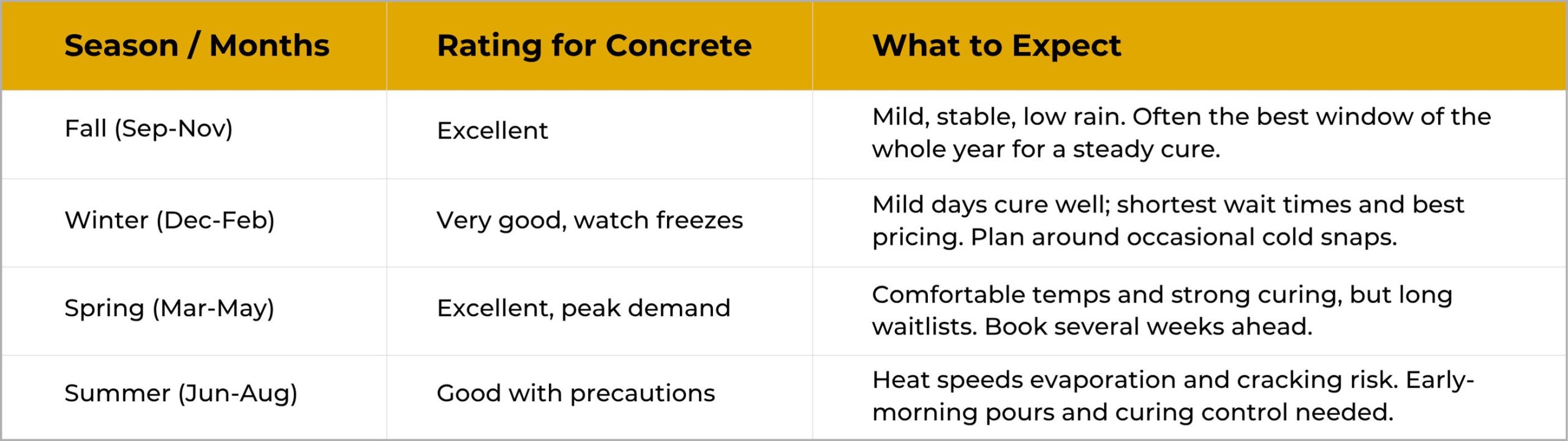
Fall, from September through November, is often the single best window of the year. The extreme summer heat has broken, rainfall tends to settle down, and days are warm while nights are cool. Concrete cures steadily and predictably, and the risk of both flash-drying and freezing is low. If you have the flexibility to choose, early fall is hard to beat.
Winter, from December through February, is better than most homeowners expect in the Upstate. Mild daytime temperatures make for excellent curing conditions, and because demand drops in the colder months, this is frequently when you will find the shortest wait times and the most competitive scheduling. The tradeoff is that a good contractor has to plan around the occasional freeze, which means keeping a close eye on the forecast and being ready to protect the slab.
Spring, from March through May, brings comfortable temperatures and is a very good time to pour. The main thing to know about spring is that it is peak season. As soon as the weather warms, homeowners across the Upstate call for driveways, patios, and pool decks all at once, which means longer waitlists and higher demand. Spring conditions are excellent, but if you want spring work, you should book well ahead.
Summer, from June through August, is entirely workable but requires the most care. The heat compresses the working time a crew has to place and finish before the surface sets, and it raises the risk of shrinkage cracking. Experienced crews handle this by scheduling pours for early morning, adjusting the mix, and using curing methods that hold moisture in the slab. Summer is also busy, so lead times run long.
Concrete Pouring Conditions by Season in Upstate SC
The table below summarizes how each season tends to perform for concrete work in the Greenville area, so you can match your project to the right window at a glance.
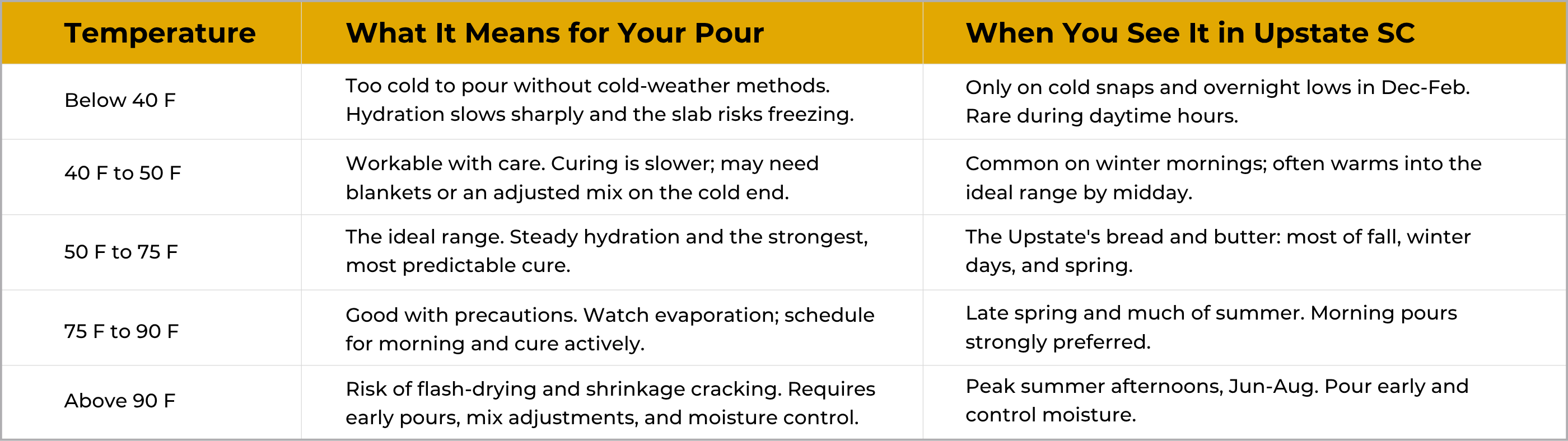
Temperature Guidelines for Pouring and Curing in the Upstate
Beyond the calendar, the actual temperature during and just after the pour is what determines the result. The table below shows the ranges that matter, what each means for your project, and when you tend to see it here in the Upstate.
How Timing Affects Concrete Cost and Scheduling in Greenville
Weather is only half of the timing question. The other half is demand. Concrete work in the Upstate follows a predictable seasonal rhythm, and that rhythm affects both how long you wait and what you pay. Spring and summer are the busy season, when nearly everyone wants their outdoor projects done at once. That surge means longer lead times and less scheduling flexibility. Fall and especially winter are quieter, which often translates into faster scheduling and more room to negotiate timing. If your project is not tied to a specific deadline, planning it for the off-season can be one of the easiest ways to save money and get on the calendar sooner. Homeowners weighing the overall investment may also find our guide on concrete patio cost in Greenville helpful for setting a realistic budget before booking.
Preparing Your Upstate SC Concrete Project for the Right Window
Once you have a target season in mind, a few practical steps help make sure the weather actually cooperates on pour day. Watch a multi-day forecast rather than a single day, since concrete needs stable conditions through its first day or two, not just a few good hours. Avoid scheduling right before heavy rain, which can ruin a fresh surface finish. Make sure the subgrade is properly prepared and drained, because a wet or unstable base undermines even a perfectly timed pour. And work with a contractor who adjusts to the season rather than pouring the same way year round. The mix, the timing of day, and the curing method should all shift with the weather. If you are still deciding on the project itself, our overview of common concrete driveway problems in Greenville explains how poor timing and preparation lead to the cracks and settling that show up years later, and how the right approach prevents them.
Why a Professional Greenville Concrete Contractor Makes the Difference
The single most important factor in timing a pour well is working with a crew that knows the local climate in its bones. A contractor who pours through Upstate summers knows exactly how early to start on a 95 degree day and which curing methods hold moisture in the slab. A contractor who works through Upstate winters knows how to read a cold front and protect a fresh pour from an overnight freeze. This local knowledge is a core part of what separates a driveway or patio that lasts thirty years from one that starts cracking in three. When you are comparing quotes, ask how the contractor plans to handle the conditions expected on your pour date. The answer tells you a great deal about the result you will get. Whether you are considering a new driveway installation or a decorative patio, the right timing and the right crew work hand in hand.
Frequently Asked Questions
What is the best month to pour concrete in Upstate SC?
Early fall, roughly September and October, is often the ideal time. Temperatures are mild, rainfall is lower, and the risk of both flash-drying and freezing is minimal, which gives concrete the steady cure it needs for maximum strength.
Can you pour concrete in winter in South Carolina?
Yes. Upstate winters are mild enough that daytime temperatures often fall in the ideal curing range, and winter frequently offers the shortest wait times and best pricing. The key is protecting the slab from the occasional overnight freeze, which an experienced local crew plans for.
Is it bad to pour concrete in the summer heat?
Summer pours are entirely workable but carry the most risk. High heat and sun can dry the surface too fast and cause shrinkage cracking. Crews manage this by pouring early in the morning, adjusting the mix, and using curing methods that keep moisture in the slab.
How long does concrete take to cure in South Carolina?
Concrete reaches enough strength to walk on within 24 to 48 hours and to drive on in about seven days, but it continues gaining strength for about 28 days. Mild, stable weather during that period produces the strongest result, which is why season matters.
Does rain affect a fresh concrete pour?
Yes. Heavy rain shortly after placement can wash out the surface finish and weaken the top layer before it sets, and a saturated subgrade can undermine the slab. This is why a stable, dry forecast matters as much as temperature when timing a pour.
Ready to Plan Your Concrete Project?
The best time of year to pour concrete in Upstate SC is whenever your project is planned around the local climate by a crew that knows how to work with it. Fall and winter offer steady curing and better scheduling, spring and summer are excellent with the right preparation, and every season here is workable when the timing is handled right. At Sampson Concrete, we pour year round across Greenville and the surrounding Upstate, matching our methods to the season so your driveway, patio, or slab is built to last. Contact us today for a free estimate and let us help you choose the right window for your project.